AMD vision loss is a spectrum. For females, it is tipped.



A new age-related macular degeneration (AMD) diagnosis is a frightening prospect for anyone. All disease stages are sight-threatening, and AMD is a lifelong condition likely to worsen over time.
But the severity of visual impairment over time varies significantly between patients, with some remaining stable and progressing slowly, and others progressing to central blindness within a few year’s of diagnosis. Many risk factors, such as genetics and obesity, increase the risk for progression to advanced disease.
As a patient, you would be anxious to know what your risks are, but unlikely to learn of the most common: Being a woman. However, AMD is treated identically in males and females, and we don’t know why this happens biologically. This is an enormous unmet clinical need, which should prompt all of us to ask:
Why are females more susceptible to blinding age-related macular degeneration (AMD), and how aren’t we already talking about this?
To address these basic yet long-neglected questions, Pearsall is taking a multifaceted approach:
Bench Science: Dr. Pearsall is studying how the immune system has different effects on blood vessel growth in males and females, which could find new treatments.
Clinical research: All published clinical papers include data from male and female patients, so studying this information helps her understand how disease works differently in men and women.
Awareness: Simply raising awareness of female patients’ risk factors could have the most immediate sight-saving effects, as this could inform treatment, improving outcomes.
Dr. Pearsall is publishing a breakthrough research paper to increase scientific visibility among AMD professionals. She hopes to raise patient and public awareness through outreach efforts and collaboration with advocacy groups for vision and vision research.
By the Numbers: What clinical data tell us
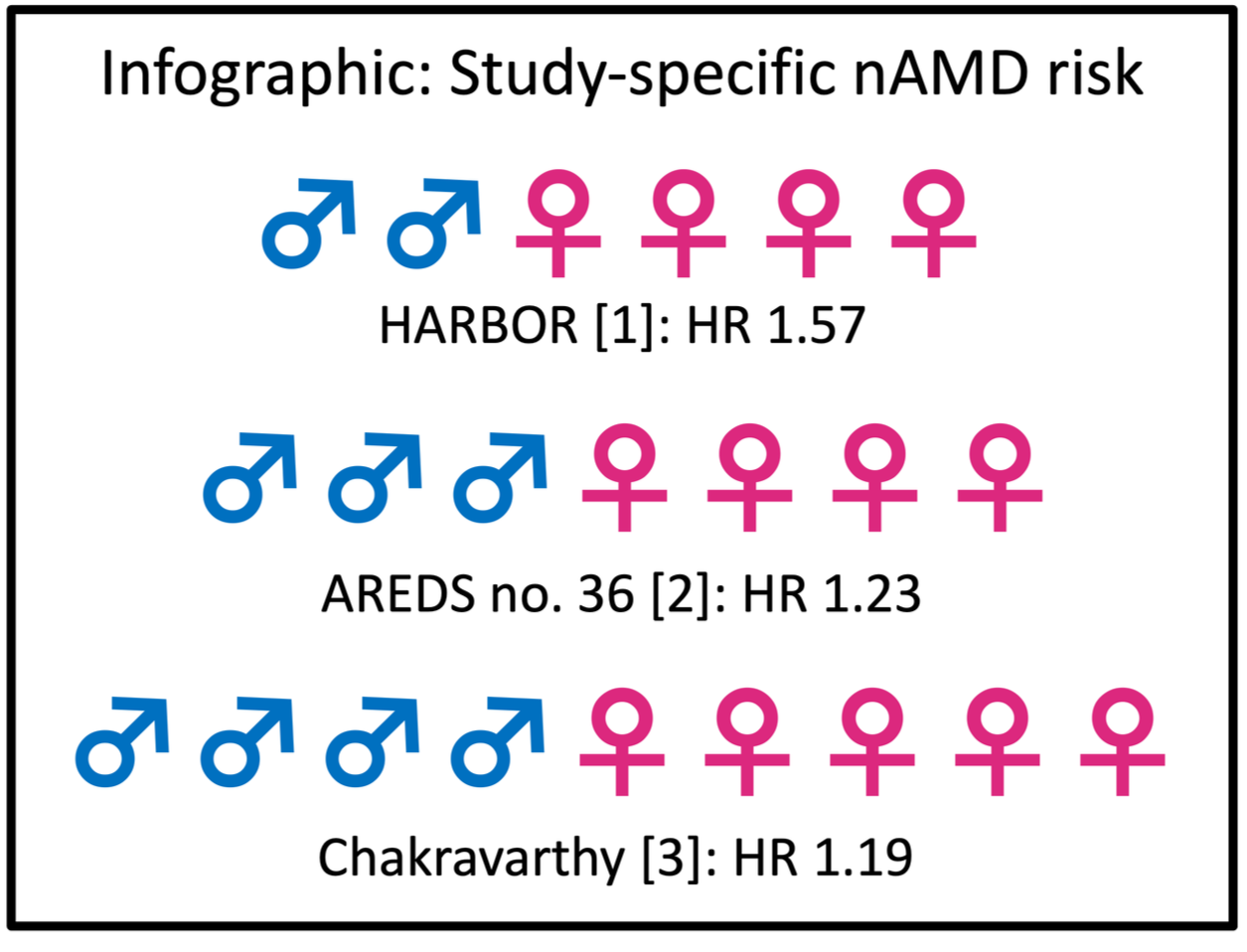
Neovascular age-related macular degeneration (nAMD), or “wet” AMD, causes 90% of AMD legal blindness. Independent of age or other variables, females more likely to develop nAMD than are males.
Dr. Pearsall frequently shares that she discovered this surprising nAMD risk factor by coincidence, when she made an unusual discovery in an animal model. She assumed that this could not carry over to human disease, as surely, such an important risk factor would be widely studied.
She was wrong, as were many of her colleagues.
Dr. Pearsall was not easily convinced — she spent several weeks reading scientific publications. She found that major studies had reported female sex as a risk factor for nAMD, but that this was an incidental finding, meaning it was reported alongside many other risk factors.
However, consistently across studies, the disease risk was reported quietly and without fanfare. Although the relative risk varied by study characteristics, as do all risk factors, the data were in.
Pearsall has since made sex differences in AMD a major proponent of her research program, which could lead to new treatments. However, and perhaps more importantly, simply making AMD professionals and the public aware of this under-recognized and understudied risk immediately could help with disease management, as doctors would know to monitor female AMD patients for AMD more frequently, and to treat it more aggressively.